
MECHANISM OF ACTION
Unlock the Skin’s Potential With Biostimulation
Harness the power of RADIESSE microspheres through a non-inflammatory pathway to stimulate a regenerative response.1

Designed to be different
RADIESSE uses calcium hydroxylapatite (CaHA) microspheres to revitalize and regenerate components of the extracellular matrix (ECM), improving the skin’s appearance and function.1,2
Activate a non-inflammatory pathway to revitalize skin1
RADIESSE activates fibroblasts, leading to skin renewal
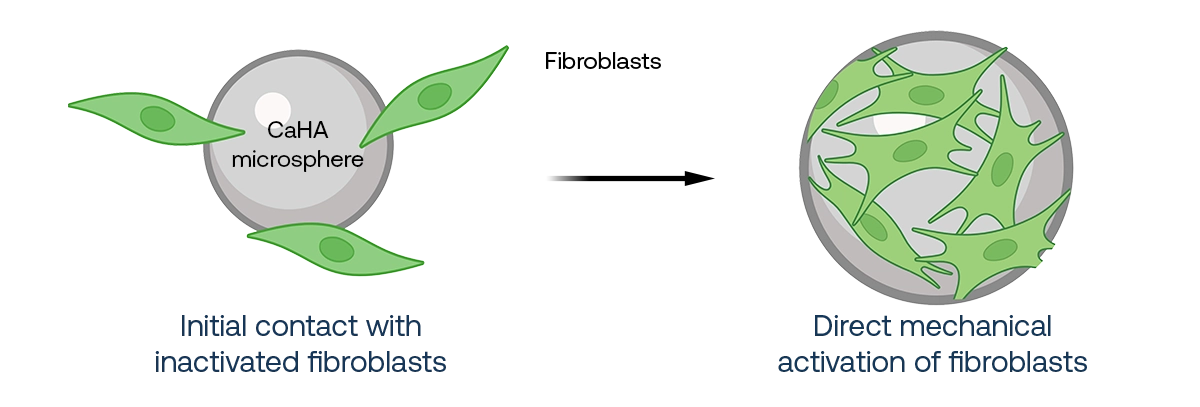
RADIESSE’s precisely manufactured calcium hydroxlapatite microspheres activate fibroblasts, which play a key role in collagen production and skin health.
DESIGNED FOR CONSISTENT OUTCOMES
- The challenges associated with an inflammatory pathway: Because the body’s inflammatory reaction can vary and be influenced by other factors, the final tissue result can be inconsistent (ie, nodule formation and inconsistent product accumulation)
- A non-inflammatory regenerative pathway: RADIESSE activates the formation of new proteins in the ECM without relying on a pronounced inflammatory response
Visualizing the non-inflammatory pathway
Get an inside look at how RADIESSE works at the molecular level, acting directly on fibroblasts to deliver predictable, regenerative results.
Our skin is formed of three layers – the epidermis, dermis and hypodermis. Skin structure and support, alongside strength and flexibility, is provided by the dermis, formed primarily of fibroblasts and extracellular matrix or ECM. Fibroblasts primarily produce ECM components and contribute to their structural organization. Key ECM components include collagen type III and type I, which provides structure and support, elastin, providing elasticity and stretch, and proteoglycans, providing tissue hydration, while angiogenesis provides nourishment.
Proliferative and regenerative ECM mechanisms are sustained by the physical contact between the ECM components and fibroblasts. As we age, a decrease in fibroblast activity and mechanical interaction reduce the production of ECM components, affecting ECM structure and weakening the skin’s mechanical properties, ultimately resulting in the appearance of wrinkles and skin laxity.
RADIESSE is a regenerative biostimulator that activates the fibroblasts and restores five key components of the ECM, to promote youthful-looking skin. RADIESSE contains calcium hydroxylapatite, CaHA, in a carboxymethylcellulose gel.
RADIESSE’s unique particle design creates the foundation of a true regenerative response, restoring the contact and tension of dermal fibroblasts and acting as scaffolding in the ECM. Direct contact with RADIESSE microspheres provides mechanical activation of fibroblasts. The fibroblast activation occurs through a regenerative mechanism of action that stimulates the body’s own natural processes to restore the five key components of the ECM. Collagen III is produced, providing structural stabilization and is replaced by collagen I over time. Collagen III ensures collagen I is aligned and mechanically robust, providing long term structural support and stability.
RADIESSE also increases elastic production, restoring elasticity to the skin and regenerates proteoglycans, providing hydration and glow.
Additionally, RADIESSE increases angiogenesis that sustains long term health of new tissue.
RADIESSE microspheres are purposely designed with minerals that are also found naturally in the body.
RADIESSE can improve the skin structure at the cellular level and delivers immediate lift and contour while providing the foundation to regenerate healthy, youthful skin.
RADIESSE – the first and only regenerative biostimulator with unique particle design that directly activates the fibroblasts, creating a true regenerative response to restore key ECM components for a more youthful appearance from the inside out.

RAPID WEIGHT LOSS
Target volume loss associated with rapid weight reduction1-3
RADIESSE’s mechanism of action supports a regenerative response that can help address facial volume loss and skin laxity observed in some patients undergoing rapid weight loss, including those treated with glucagon-like peptide-1 (GLP-1) therapies.
BIOSTIMULATION FOR THE BODY
A new era for the décolleté2
Learn more about the specialized 1:2 hyperdilution protocol and see results from the pivotal trial.
BECOME A RADIESSE PROVIDER
Ready to Re-Awaken your patients’ skin from within?

Actual patients. Individual results may vary.
Indication:
RADIESSE® and RADIESSE® (+) Injectable Implants are FDA-approved for subdermal implantation for the correction of moderate to severe facial wrinkles and folds, such as nasolabial folds.
RADIESSE® is also indicated for hand augmentation to correct volume loss in the dorsum of the hands, as well as décolleté wrinkles correction in patients 22 years of age and older, when diluted 1:2 with 0.9% sterile saline solution.
RADIESSE® (+) is also indicated for deep injection (subdermal and/or supraperiosteal) for soft tissue augmentation to improve moderate to severe loss of jawline contour in adults over the age of 21.
RADIESSE® and RADIESSE® (+) IMPORTANT SAFETY INFORMATION:
Contraindications:
Do not use RADIESSE® or RADIESSE® (+) in patients who have severe allergies, including a history of anaphylaxis or multiple severe allergies, known hypersensitivity to any of the product’s components, bleeding disorders. RADIESSE® (+) is contraindicated in patients with known hypersensitivity to lidocaine or anesthetics of the amide type.
Warnings:
Intravascular injection may lead to embolization, occlusion of the vessels, ischemia, or infarction. Take extra care when injecting soft tissue fillers, for example, injecting the product slowly with minimal pressure. Rare but serious adverse events associated with the intravascular injection of soft tissue fillers in the face included temporary or permanent vision impairment and blindness, cerebral ischemia or cerebral hemorrhage, leading to stroke and skin necrosis. Damage to underlying facial structures. Immediately stop the injection if the patient experiences changes in vision, signs of a stroke, blanching of the skin, and unusual pain.
The treating physician should be knowledgeable regarding any pretreatment evaluation and appropriate interventions in the event of intravascular disseminated injection. Prompt intervention by an appropriate medical specialist should be given to these signs or symptoms of intravascular injection occur. Use of these products in any person with active skin inflammation or infection in or near the treatment should be deferred until the inflammatory or infectious process is controlled.
The CaHA particles in RADIESSE® are radiopaque and clearly visible on CT scans and may be visible on standard X‑rays. Patients should be advised to inform their healthcare providers and radiologists. Some injectable implants have been associated with tissue hardening at the injection site, particle migration, and allergic or autoimmune reactions.
Do not overcorrect (overfill) a contour deficiency with these products.
Injections of RADIESSE® Injectable Implant diluted 1:2 with 0.9% sterile saline should not be made in an area overlying or including breast tissue.
Injection into the dorsum of the hand may cause adverse events that last for more than 14 days and may result in temporary difficulty performing activities (48% of study patients reported this adverse event). RADIESSE® may cause nodules, bumps or lumps in the dorsum of the hand (12% reported this event) and can last up to 1 year. The safety and effectiveness for use in the lips has not been established. There have been published reports of nodules associated with the use of these products injected into the lips.
Precautions:
In order to minimize the risk of potential complications, this product should only be used by trained and experienced healthcare practitioners who are knowledgeable about the anatomy at and around the injection site. Healthcare practitioners should fully review all product educational materials and the entire package insert. For use in the correction of wrinkles in the décolleté, completion of an indication-specific training program is required for all users.
Safety and effectiveness has not been established for:
- Use beyond 3 years in the face, 1 year in the hand and 84 weeks in the décolleté
- Treatment in the periorbital area
- Interaction with drugs or other substances or implants
- Use during pregnancy, in breastfeeding women or patients under 22 years old
- Décolleté treatment in patients under 22 years old, patients with cancer or previous radiation treatment near or in the area to be treated, patients who have had breast cancer, a history of breast cancer, or a familial history of breast cancer
- Patients who have systemic or localized autoimmune or granulomatous disease
- Dorsum of the hand treatment in patients under 26 years old and over 79 years old
- Patients prone to keloid formation and hypertrophic scarring
- Use with concomitant dermal therapies such as epilation, UV irradiation, or laser, mechanical, or chemical peeling procedures
- Injections exceeding 18 mL diluted 1:2 (6 mL of RADIESSE® and 12 mL of saline solution) cumulatively over a series of 4 injections
Additional considerations include:
- Do not use where there is active disease such as tumors in or near the intended treatment site.
- As with all transcutaneous procedures, injection of these products carries a risk of infection. Injection in the jawline may temporarily alter jaw function.
- Use in the dorsum of the hand may result in significant swelling of the dorsum of the hand.
- Special caution should be exercised when treating areas in close proximity to breast implants.
- To help avoid needle breakage, do not attempt to straighten a bent needle or cannula. Discard it and complete the procedure with a replacement needle.
- Patients who are using medications that can prolong bleeding, such as aspirin or warfarin, may experience increased bruising or bleeding at the injection site.
- Patients with a history of previous herpetic eruption may experience reactivation of the herpes.
- Patients should minimize strenuous activity and exposure of the treated area to extensive sun or heat exposure for approximately 24 hours or until any initial swelling and redness has resolved.
Adverse Events:
Common adverse events observed in clinical studies of RADIESSE® or RADIESSE® (+) include bruising, redness, swelling, pain, itching, lumps/bumps at site of injection, difficulty chewing and other local side effects.
Cases of delayed-onset inflammation have been reported to occur at the dermal filler treatment site following viral or bacterial illnesses or infections, vaccinations, or dental procedures. Typically, the reported inflammation was responsive to treatment or resolved on its own.
Information on adverse events from post-market surveillance of RADIESSE® and RADIESSE® (+) are included in the Instructions for Use (IFU) and Patient Information Guide (PIG) based on an assessment of seriousness and potential causal relationship to RADIESSE® or RADIESSE® (+). Please see the IFU and PIG available at www.radiesse.com for a complete list of these events.
To report a problem with RADIESSE® or RADIESSE® (+), please call MyMerz Solutions at 1-844-469-6379.
For complete Safety Information please refer to the Instructions for Use at Radiesse.com.
Rx only
References: 1. Aguilera SB, et al. Aesthet Surg J. 2023;43(10):1063-1090. 2. Radiesse [Instructions for Use]. Franksville, WI: Merz North America, Inc; 2026. 3. Ridha Z, et al. Aesthet Surg J. 2024;44(11):NP809-NP818.